Hello everybody, hope you’re having an incredible day today. Today, I will show you a way to make a special dish, ‘gunkan’ maki sushi. One of my favorites. This time, I am going to make it a bit unique. This is gonna smell and look delicious.
‘Gunkan’ Maki Sushi is one of the most popular of current trending meals on earth. It’s enjoyed by millions daily. It is easy, it’s quick, it tastes yummy. ‘Gunkan’ Maki Sushi is something that I have loved my entire life. They’re nice and they look wonderful.
Gunkan Maki - The Battleship Wrapped in Seaweed. To appreciate the nature of gunkan sushi invariably referred to as gunkan maki, it helps to dig a little deeper to understand what maki is. This invention enabled the use of soft loose ingredients as a sushi topping.
How to Prepare ‘Gunkan’ Maki Sushi
To get started with this particular recipe, we must prepare a few components. You can cook ‘gunkan’ maki sushi using 11 ingredients and 5 steps. Here is how you can achieve it.
Ingredients
The ingredients needed to make ‘Gunkan’ Maki Sushi:
- Prepare Sushi Rice
- Take Nori
- Prepare Your Favourite Toppings
- Take <Topping Suggestions>
- Get Fresh Sashimi Slices, Wasabi
- Make ready Ikura (Salmon Roe), Tobiko (Flying Fish Roe)
- Prepare Crab Meat, Prawns
- Make ready Teriyaki Chicken, Inari-zushi Wrappers
- Take Tuna & Mayonnaise
- Take Scrambled Egg, Boiled Egg & Mayonnaise
- Take Avocado, Cucumber, Corn
Uni gunkan maki is a traditional Japanese type of sushi that comes in the elongated shape of a ship (gunkan). This version of gunkan is made with uni or sea urchin gonads as a topping for nori-wrapped sushi rice. The flavors are sweet, rich, and creamy, with notes of the sea. The texture is delicate and melting in the mouth.
Instructions
Steps to make ‘Gunkan’ Maki Sushi:
- Cook Sushi Rice. Sushi rice should be cool or room temperature. *Find my 'Sushi Rice' recipe at https://cookpad.com/uk/recipes/1467168-sushi-rice
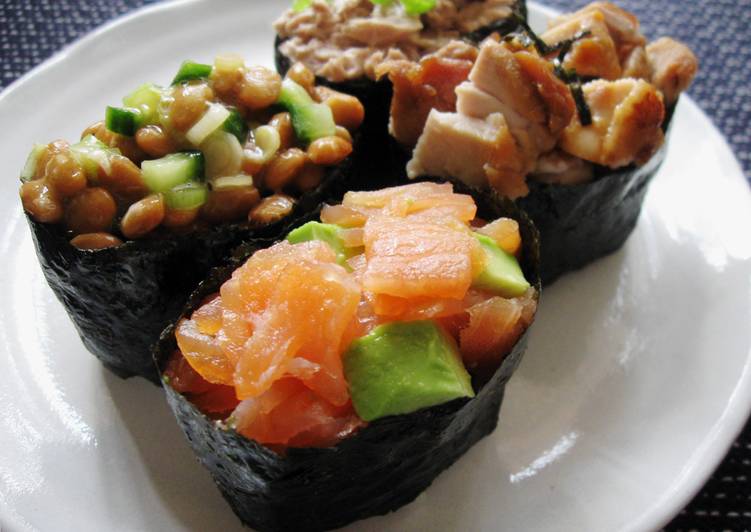
- Prepare toppings. - *Today I made four different toppings, ‘Smoked Salmon & Avocado’, ‘Teriyaki Chicken’, ‘Nattō & Cucumber with Spring Onion’ and ‘Canned Tuna & Mayonnaise with Spring Onion’
- Cut a sheet Sushi Nori into 6 strips. Nori sheet is usually 20cm long. When you cut it into 6 strips, each strip would be 3.3cm in width. Cut each strip to make 15-16cm long. Offcuts can be used for topping or other dishes.
- Make small oblong Sushi Rice balls. Usually about 20g of rice is formed into a ball, and that’s quite small. Flatten or hollow the top. - *Note: You may wish to purchase Sushi Moulds, but ice cube tray could be an alternative tool to make many balls quickly.
- Wrap each ball with a Nori strip with the smooth side out, place toppings on top.
Recipe: Gunkan Maki (Battleship Sushi) by Chris Kresser, M. A fun and easy snack with a bright vibrant color. This Gunkan Maki sushi recipe is easy to make at home. It is topped with ikura (fish eggs, larger than tobiko, which is what was used on the Boston Roll), so it is very salty. We also used some wasabi tobiko (the smaller green fish eggs), but contrary to what their name claims, they didn't really add any spice to the sushi.
As simple as that How to Prepare ‘Gunkan’ Maki Sushi
So that is going to wrap it up with this exceptional food ‘gunkan’ maki sushi recipe. Thanks so much for your time. I am confident that you will make this at home. There’s gonna be interesting food in home recipes coming up. Don’t forget to bookmark this page in your browser, and share it to your loved ones, friends and colleague. Thank you for reading. Go on get cooking!
Print this page