Hello everybody, I hope you are having an amazing day today. Today, I’m gonna show you how to prepare a distinctive dish, kue koci. One of my favorites. This time, I’m gonna make it a little bit unique. This will be really delicious.
Kue Koci is one of the most well liked of recent trending foods on earth. It’s appreciated by millions every day. It is easy, it’s quick, it tastes delicious. They’re nice and they look fantastic. Kue Koci is something which I’ve loved my whole life.
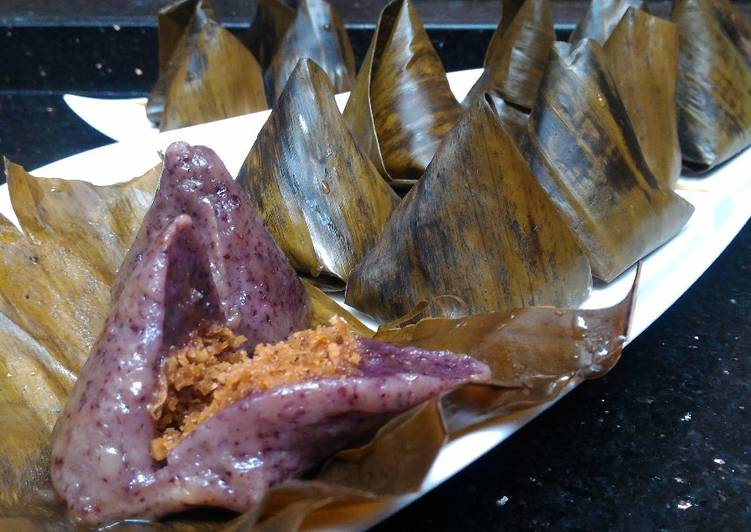
It is traditional Indonesian snack, steamed glutinous rice flour with sweet grated coconut filling wrapped in banana leaves. Sweet grated coconut is made from fresh young grated coconut, some water and palm sugar, cook it over low heat, stirring often until the liquid. Kue kochi or koci (also known as passover cake in English) is a Maritime Southeast Asian dumpling (kue or kuih) found in Javanese, Malay and Peranakan cuisine, made from glutinous rice flour, and stuffed with coconut fillings with palm sugar.
Steps to Prepare Kue Koci
To begin with this particular recipe, we have to first prepare a few components. You can cook kue koci using 14 ingredients and 7 steps. Here is how you can achieve that.
Ingredients
The ingredients needed to make Kue Koci:
- Get For the filling:
- Prepare 300 g young grated coconut
- Take 150 g palm sugar
- Get 50 ml water
- Prepare 2 pandan leaves, torn small
- Take 1 tsp glutinous rice flour
- Take 1 pinch salt
- Prepare For the glutinous rice dough:
- Get 4 tbsp. black glutinous rice. Soak over night, blend with some of coconut milk until smooth
- Make ready 300 g glutinous rice flour
- Prepare 250 ml coconut milk
- Take 1 tbsp. sugar
- Get 1 pinch salt
- Take Banana leaves for wrapping, cut into 10cm diameter round
Maka dari itu pada kesempatan ini resepkuerenyah akan memberikan resep kue koci agar Anda bisa membuatnya sendiri di rumah. Kuih koci merupakan sejenis kuih tradisional yang popular di Malaysia, Indonesia, dan Singapura. Kuih ini diperbuat dari tepung pulut dan mempunyai inti kelapa manis bercampur gula nisan (Gula Melaka) di dalamnya. Di Malaysia ia popular terutama di kawasan Pantai Timur iaitu di Kelantan dan Terengganu.
Instructions
Steps to make Kue Koci:
- For the filling: put together sugar, salt, pandan leaves and water into a sauce pan, bring to boil until the sugar has melted.
- On low heat, add in grated coconut, and cook until the liquid is almost evaporated.
- Sprinkle in the glutinous rice flour, continue cooking until there is no liquid left.
- For the glutinous rice dough: put all ingredients in a large mixing bowl, knead well to form a smooth dough. Divide the dough equally into 15 pieces.
- Put one piece of dough on your palm, flatten it.
- Add 1 tsp the filling in the centre of the dough, gather up the edges to seal the filling inside.
- Fold a piece of banana leaf into a cone, put in the filled dough, wrap and tuck in with a toothpick the end neatly. Steam for 15-20 minutes.
Ia kemudiannya disalut dengan santan sebelum dibalut dengan daun pisang dan dihidangkan. Resep Kue Bugis Yang Lembut Lentur dan Gak alot Sekilas mungkin hampir mirip dengan kue bugis yang juga berbahan dasar tepung ketan dan dibungkus daun pisang, namun kue koci memiliki bentuk berbeda. Kalau kue bugis biasanya berbentuk bulat pipih, kue koci memiliki bentuk seperti kerucut. Jika kalian tidak pernah menikmatinya, jangan khawatir.
As simple as that Recipe of Kue Koci
So that is going to wrap this up for this exceptional food kue koci recipe. Thank you very much for your time. I am sure you can make this at home. There is gonna be more interesting food at home recipes coming up. Don’t forget to bookmark this page in your browser, and share it to your family, colleague and friends. Thank you for reading. Go on get cooking!
Print this page